
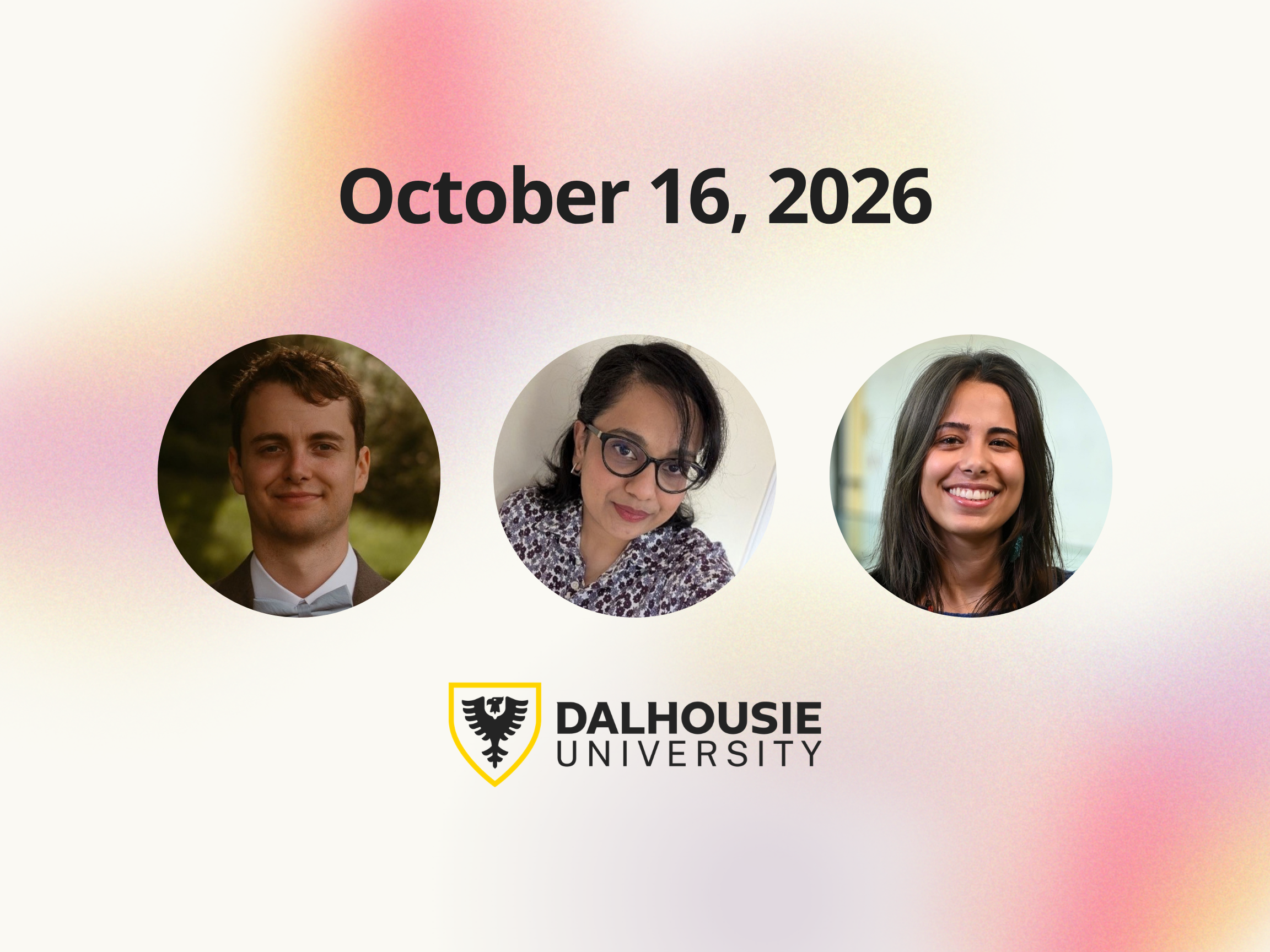
Microbiome analysis is being used to understand microbial biodiversity and ecological functions in many habitats. A crucial step in analysis is determining which microbes are present. The answer you get can be highly dependent on your choice of DNA sequencing and bioinformatics methods, and all methods require you to choose magic parameters and thresholds to decide what is there. Today’s presenters are researchers who have thought carefully about these methods, and they will share their insights into what works and where the key limitations lie. We will additionally learn about an exciting outreach project to make bioinformatics methodologies more accessible to students and scientists across the world!
If you would like to attend in person, we kindly ask that you complete this form so we can estimate food quantities (to minimize food waste) and support dietary restrictions. Completion of this form is anonymous. You are still welcome to attend if you do not complete the form ahead of the networking event.
| Time | Description | Location |
|---|---|---|
| 12:00 | Seminar | In Person: Room 1201, Mona Campbell Building, 1459 Lemarchant St, Halifax, NS
Virtual: MS Teams |
| 13:00 | Refreshments and Networking | Lobby, Mona Campbell Building, 1459 Lemarchant St, Halifax, NS |
Meet our Speakers:


Jacob Nearing
Jacob Nearing completed his undergraduate degree and PhD in Microbiology and Immunology at Dalhousie University. Under the supervision of Dr. Morgan Langille, his doctoral research examined how microbial communities in the oral cavity are associated with lifestyle behaviours, demographic factors, and cancer diagnoses. He also investigated how the choice of bioinformatics tools can influence the biological conclusions drawn from microbiome studies authoring a landmark paper on how differing statistical methods for microbiome research can alter biological conclusions. Following his PhD, Jacob moved to Boston to join Dr. Curtis Huttenhower's laboratory at Harvard University. There, he continued his research on the human microbiome, developed several bioinformatics tools that improved statistical associations with microbiome data and the assignment of taxonomy to sequencing reads. Apart from his bioinformatics work Jacob also investigated how diet alters the gut microbiome in canine models. Jacob is currently a postdoctoral fellow in Dr. Morgan Langille's laboratory, where he works jointly with the Dr. Curtis Huttenhower's laboratory to improve the characterization of functional variation in the human microbiome. To date, he has published 19 papers, including nine as first author and one as senior author, in journals such as Nature Communications, PNAS, Nucleic Acids Research, and Nature Methods.

Sneha Surya Narayana Murthy
5th Interdisciplinary PhD candidate, Faculty of Computer Science, Dalhousie University, supervised by Dr. Robert Beiko. Research at the intersection of computational metagenomics and freshwater microbial ecology. Holds a Bachelor of Engineering in Biotechnology and a Master’s in Bioinformatics from Bangalore, India. Trained in sequence analysis and computational biology. Broader interests in metagenomics, microbial genomics, and environmental and human microbiomes. Doctoral research on shotgun metagenomics of agricultural river systems. A three-year, multi-site time series from Prince Edward Island, examines seasonal, interannual and spatial patterns in microbial community composition and functional potential. Ongoing work develops an abundance-tiered benchmarking framework for eleven taxonomic profilers spanning k-mer, marker-gene, sketching, phylogenetic and machine-learning approaches. Sequencing-depth subsampling and limit-of-detection analysis evaluate rare-taxon detection in poorly referenced environments.

Letícia Magpali
I’m currently a biology graduate student at Dalhousie University (Halifax, NS, Canada) and part of the Bielawski Research Group, where I’m supervised by Joe Bielawski. I am also a member of the Laboratory of Evolutionary Genomics (Campinas, SP, Brasil), led by my co-supervisor Mariana Nery. My research aims to understand how cetaceans (whales, dolphins and porpoises) have evolved their complex acoustics in different environments and social contexts. For that I’m using both genomic and phenotypic data, to get an integrated perspective on the evolutionary processes that created the amazing acoustic diversity we see in cetaceans today.
Meet our Host

Rob Beiko
Rob (or “Dr. Robert Beiko”, if you want to be all formal about it) is an Associate Professor in Bioinformatics in the Faculty of Computer Science at Dalhousie University. Before coming to Dal in 2006, he was a postdoc in the lab of Mark Ragan at the University of Queensland in Brisbane, Australia. And before that, he completed a PhD in Biology at the University of Ottawa (1998-2003). Although all of his formal training was in biology, an interest in machine-learning approaches, algorithms for identifying important evolutionary events, and visualization of biological data have ultimately led him to put down stakes in Computer Science and collaborate with some of the best in the business here.

